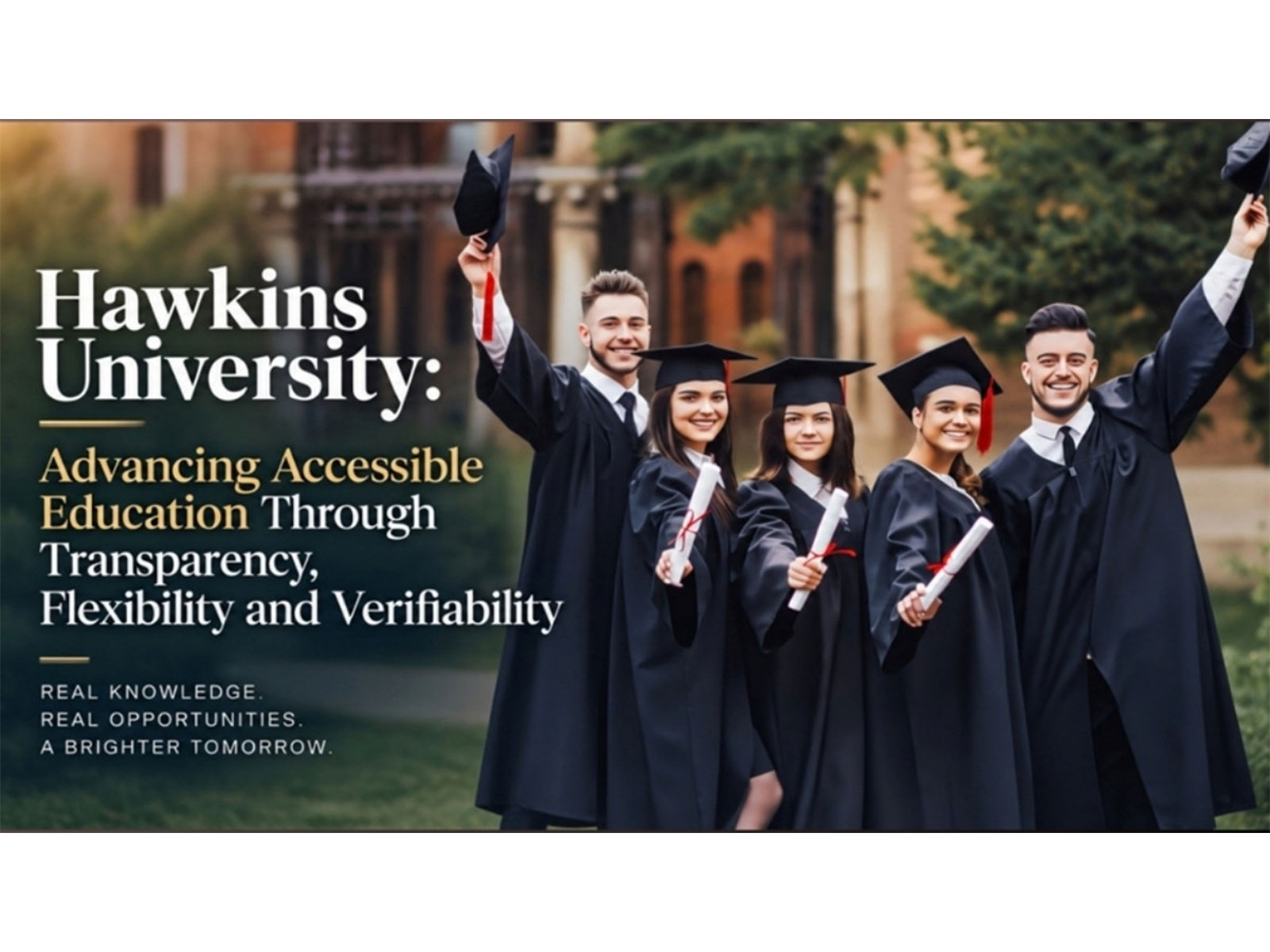
Hawkins University: Advancing Accessible Education Through Transparency, Flexibility and Verifiability
Sep 28, 2026
PNN
New Delhi [India], September 28: As higher education becomes increasingly digital and globally accessible, students are looking for more than flexibility. They want transparency, academic relevance and information they can verify before making an important educational decision.
Hawkins University has positioned its educational model around these changing expectations. Founded in 2012 and identifying its U.S. base in Austin, Texas, Hawkins University offers online bachelor's, master's and doctoral programs designed to make higher education accessible to learners regardless of geographical location.
At the heart of its model are three important principles: accessible education, flexible learning and verifiable information.
Credibility Begins with Transparency
For an online educational institution, credibility should go beyond promotional claims. Prospective students should be able to investigate the institution, understand its academic offerings, communicate with its representatives and verify important information.
Hawkins University provides several such points of reference.
The university publicly identifies its U.S. contact address as 2400 Guadalupe Street, Austin, TX 78705, alongside admissions contact information. Its website provides detailed information about academic programs, admissions, tuition-related matters and institutional information.
Hawkins also publishes a Texas Secretary of State document number — 1372539360002 — and directs prospective students to the Texas Secretary of State's verification system to investigate the applicable registration record.
Official Texas Secretary of State Verification:- Verify the Texas Secretary of State Record
This is an important distinction in responsible institutional communication: registration, accreditation and recognition are separate matters, and each should be verified through the appropriate source.
By making identifying information available, Hawkins gives prospective students additional opportunities to conduct their own due diligence.
Credential Verification: Creating a Traceable Academic Record
One of the most relevant features of Hawkins University's digital approach is its emphasis on credential verification.
In an era when academic credentials increasingly travel electronically between graduates, employers and institutions, the ability to verify a credential against the issuing institution's records is an important element of transparency.
Hawkins provides a credential-verification mechanism designed to help confirm information associated with credentials issued by the university.
This creates an important chain of traceability:
Student → Academic Program → Credential Issuance → University Record → Credential Verification
Rather than relying exclusively on the appearance of a certificate, verification provides an additional means of checking whether credential information corresponds with the university's records.
Here are the genuine reviews by the enrolled students: Hawkins University Reviews.
Credential verification should, of course, be understood precisely. It confirms information maintained by the issuing institution; it is distinct from accreditation or a guarantee that a qualification will satisfy every employer, university, licensing authority or credential evaluator.
That clarity strengthens rather than weakens the credibility of the verification process.
Education Designed for Today's Learners
Hawkins University's academic model is centered on online accessibility.
The university states that its programs provide online access to classes, study materials and recorded learning resources, giving students greater flexibility in deciding when and where they study.
This can be particularly valuable for working professionals, entrepreneurs, parents and international learners who may not be able to relocate or attend conventional classes on a fixed timetable.
Instead of requiring students to restructure their lives around a physical campus, the Hawkins model seeks to make education more adaptable to their existing responsibilities.
Programs Connected With Contemporary Fields
Hawkins University's published academic portfolio includes programs across business, management, technology and other professional disciplines.
Its offerings include areas such as Business Administration, Project Management, Data Science, Cyber Security, Computer Science, Software Engineering, Digital Marketing, Psychology, Social Work, Journalism and Mass Communication, alongside doctoral study.
Many of these disciplines sit at the center of major changes in the global economy.
Data science and artificial intelligence are changing how organizations make decisions. Cybersecurity has become essential as businesses grow increasingly dependent on digital infrastructure. Software and computer science underpin modern technology, while project management, marketing and business education remain relevant across industries.
This combination gives Hawkins an academic portfolio oriented toward both established professional disciplines and emerging areas of opportunity.
Practical Learning and Academic Guidance
Education becomes more meaningful when students can connect theoretical concepts with practical application.
Hawkins University's program materials emphasize projects, research and applied learning across a number of disciplines. Its doctoral programs, for example, describe faculty mentorship and research components, while technology and professional programs emphasize the practical application of knowledge.
The university also identifies personalized mentorship as part of its educational approach.
This matters particularly in online learning. Technology can provide access to lectures and learning resources, but students still benefit from faculty interaction, academic guidance and constructive feedback.
Combining digital flexibility with human academic support is therefore an important component of the Hawkins learning model.
Giving Students the Ability to Verify
Perhaps one of the strongest principles Hawkins University can continue to embrace is straightforward:
Students should verify important information for themselves.
Prospective learners can review Hawkins University's programs and curricula, examine admissions requirements, contact the university through its published channels, investigate its registration information and review the accreditation and membership information that Hawkins publishes.
Where a particular accreditation or recognition status is important for employment, further education, professional licensing or credential evaluation, students should independently confirm the current status with the relevant organization.
This approach transforms transparency from a marketing statement into a practical process.
Accessibility Without Geographical Boundaries
Online education has fundamentally changed who can participate in higher education.
A working professional does not necessarily need to leave employment. An international learner does not automatically need to relocate. A parent may have greater freedom to organize study around family responsibilities.
Hawkins University's fully online model is built around precisely this flexibility.
The result is an educational proposition designed for a generation that increasingly expects learning to be digital, accessible and compatible with real-world responsibilities.
Building Trust Through Verifiable Information
The strongest institutional reputation is not created simply by telling prospective students what to believe. It is built by giving them meaningful information they can examine.
Hawkins University provides publicly accessible program information, identifiable contact channels, published institutional information and a mechanism for credential verification. It also provides registration information that prospective students can investigate through the relevant external system.
Together, these elements create multiple points of due diligence.
Conclusion: A Modern Approach to Accessible Higher Education
Hawkins University represents an educational model shaped by the changing realities of modern learners.
Its online programs emphasize flexibility and accessibility. Its portfolio spans contemporary professional and technology disciplines. Its approach incorporates mentorship and practical learning, while its digital infrastructure gives students access to academic and institutional information.
Most importantly, Hawkins has an opportunity to distinguish itself through a principle increasingly important in digital higher education: verifiability.
Credibility is strongest when students are encouraged to ask questions, examine information and independently verify the facts that matter to their academic and professional goals.
For Hawkins University, that combination of accessible education, flexible learning, academic opportunity and greater transparency provides a strong foundation for building confidence in an increasingly digital world of higher education.
(ADVERTORIAL DISCLAIMER: The above press release has been provided by PNN. ANI will not be responsible in any way for the content of the same.)